OPENING QUESTIONS:
How did your model work? What revisions did you have to make? Please converse.
═══════════════════════════
WORDS O' THE DAY:
- Work (Force through displacement)
- Dot Product ("scalar product")
- Work ("Newton meter (Nm)" or "Joule (J) ")
- Hooke's Law (F = -kx)
- Work done by or done on a spring = 1/2kix2 - 1/2kfx2
- Kinetic energy of an object in motion = 1/2mv2
- Potenial energy in a compressed spring = 1/2kx2
FORMULAE OBJECTUS:
-
Work = fdcosθ (including the integral form)
-
F = -kx (note the negative sign)
-
Potential Energy of a spring = 1/2kx2
-
Kinetic Energy of an object = 1/2mv2
-
Gravitational Potential Energy = U = mgh
- Fx=-dU/dx (relationship between force in one dimension and the change in
- potential energy in that dimension). The AP usually writes this equation as
- a partial derivative Fx=-∂U/∂x. For our purposes we will treat them
- as one and the same
- ∆E = 0: Conservation of Energy
- ∆E = ∆KE + ∆U
- ∆KE = Work
- -∆U = Work
- ∆W/∆t = average power
- dE/dt = instantaneous power
WORK O' THE DAY:
Notice that when you emphasize the physics and THEN apply the formulae that life (often?) get's a whole lot easier... let's please keep than in mind as we mush on!
Let's have someone come up and lead us in a review of main concepts regarding work & conservation of energy.
═══════════════════════════
The last wee bit we have to work on for this unit is POWER.
A coupla weeks ago someone asked about horsepower. We see that regularly in pretty little blue sports cars, motorcyles and power generation (1 megawatt needs to be generated to provide power to 2500 households for example)
Anywho.... there are just two things to keep in mind:
Average power is DEFINED to be the change in energy divided by the change in time:
∆E/∆t
although we have been concentrating on WORK as the means whereby energy is transferred so:
∆W/∆t
will be our go to formulae for AVERAGE power.
As you might have surmised, we can use calculus to find instantaneous power:
dE/dt
Side NOTE:
- First we learned about displacement (meters)
- Then we learned about velocity (meters/second)
- Then we learned about acceleration (meters/second/second)
- Then we learned about force (kgm/s/s = Newtons)
- Then we learned about Work/Energy (Nm=Joules)
- Now we have Power (J/s=Watts) *whew*
HOMEWORK:
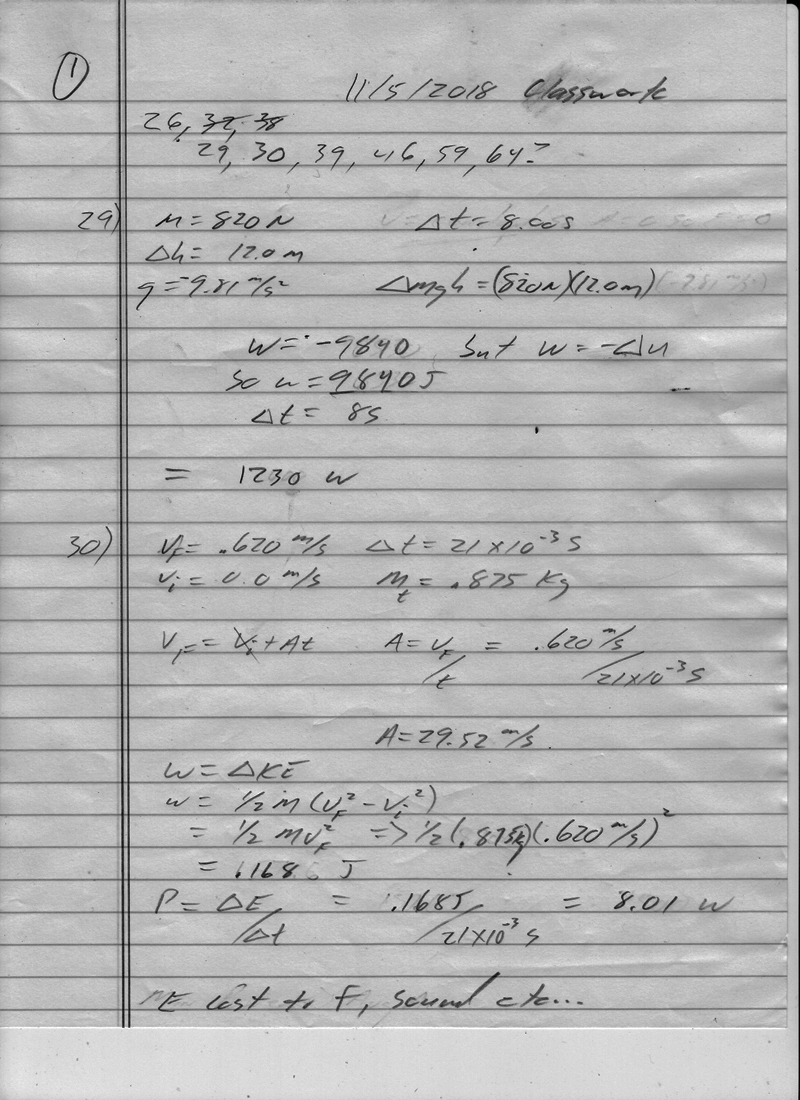
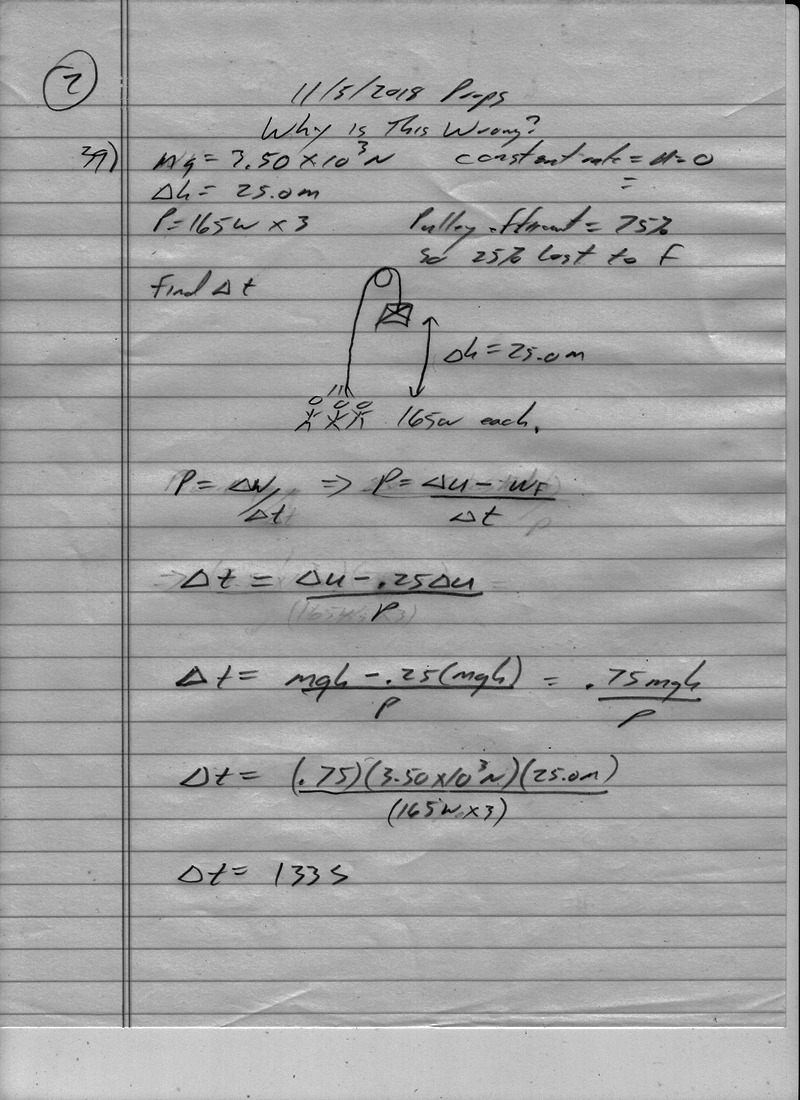
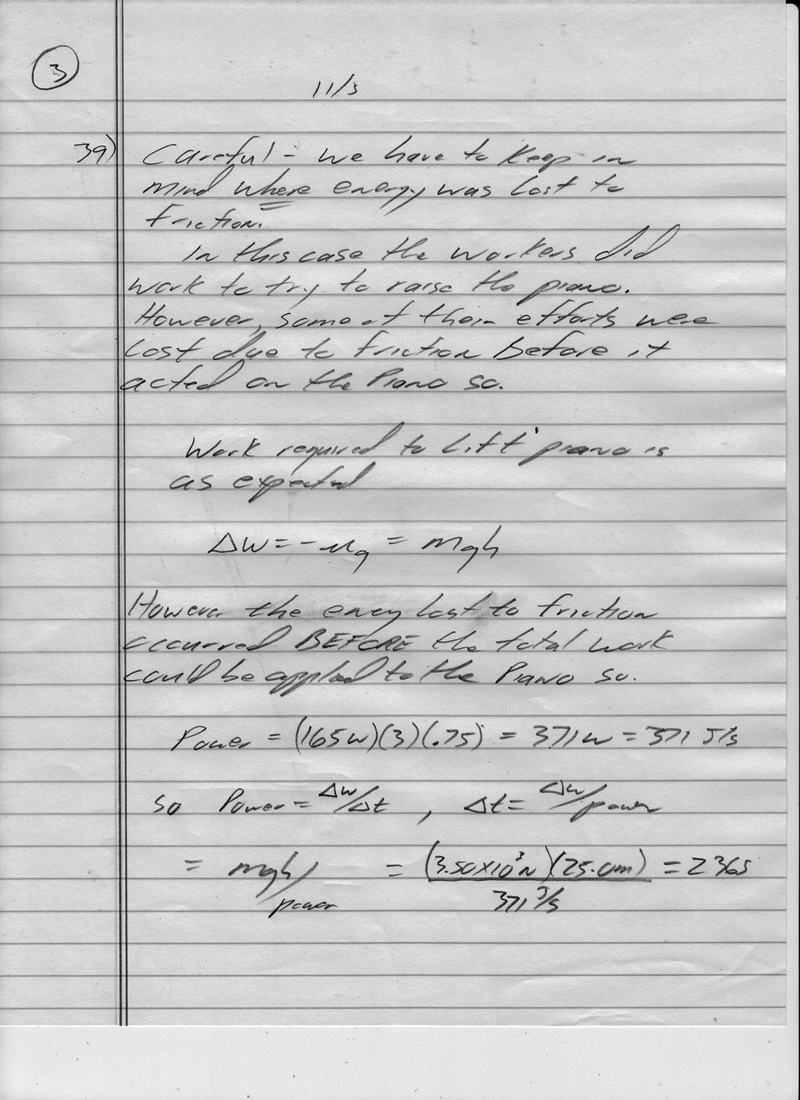
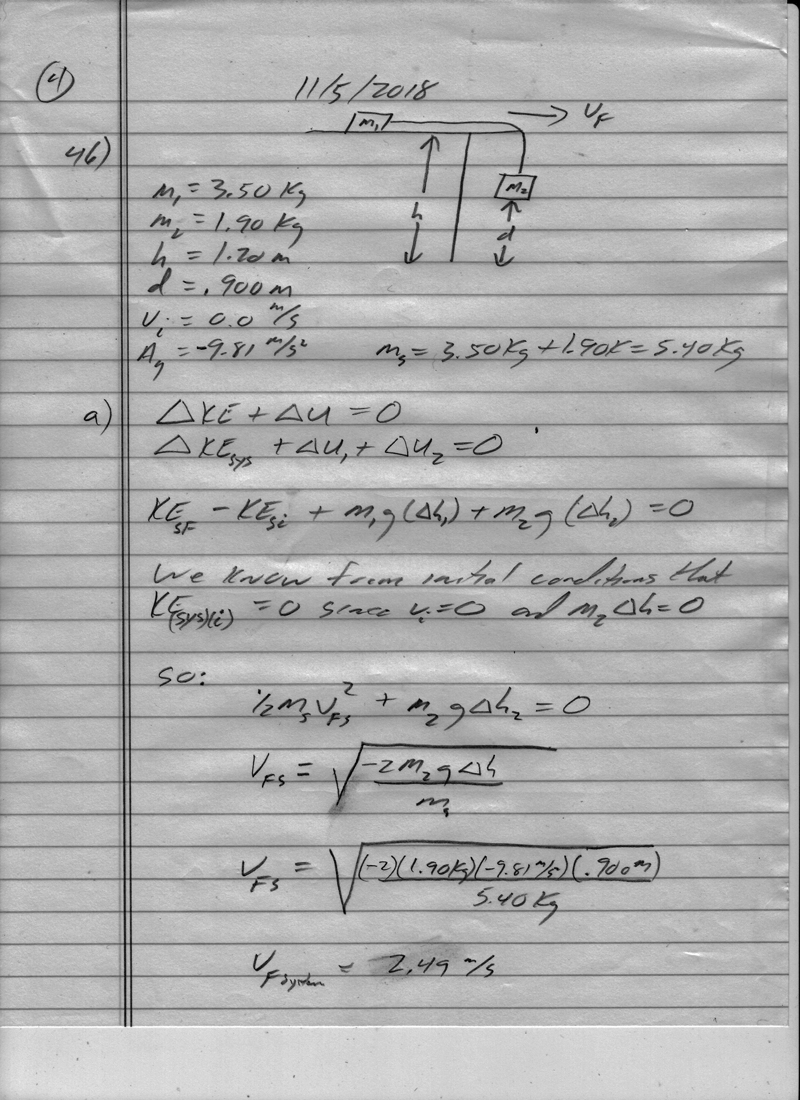
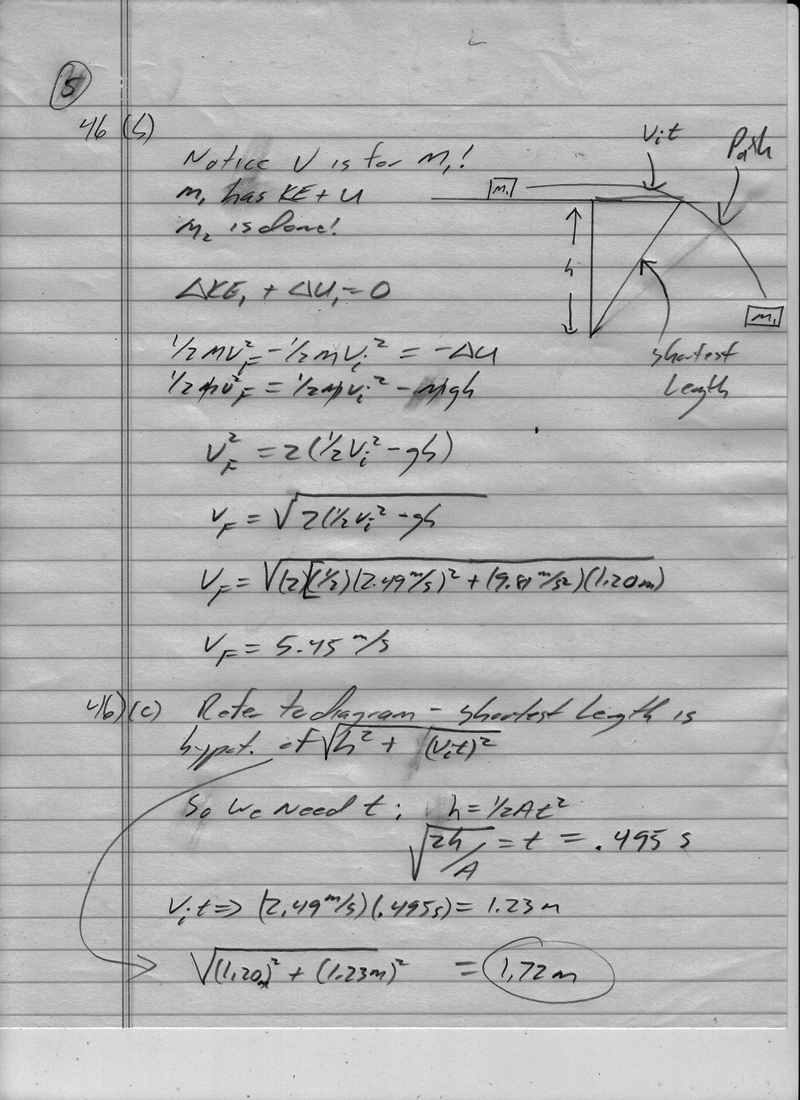
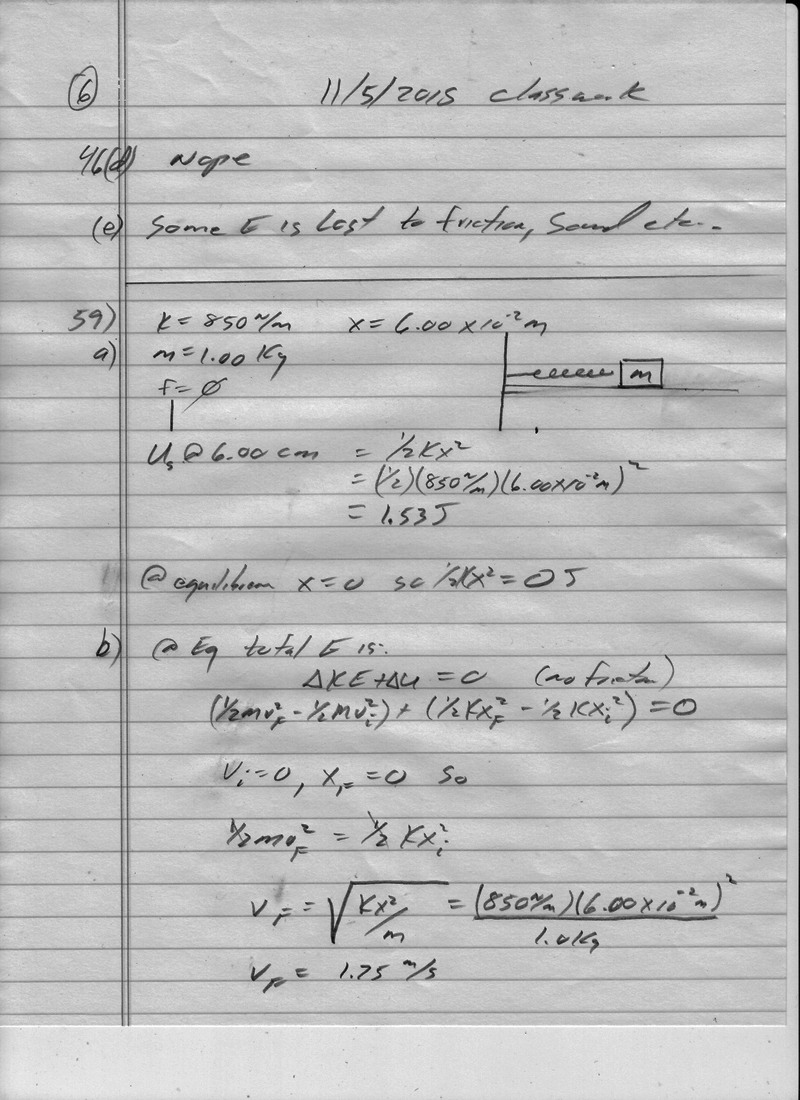
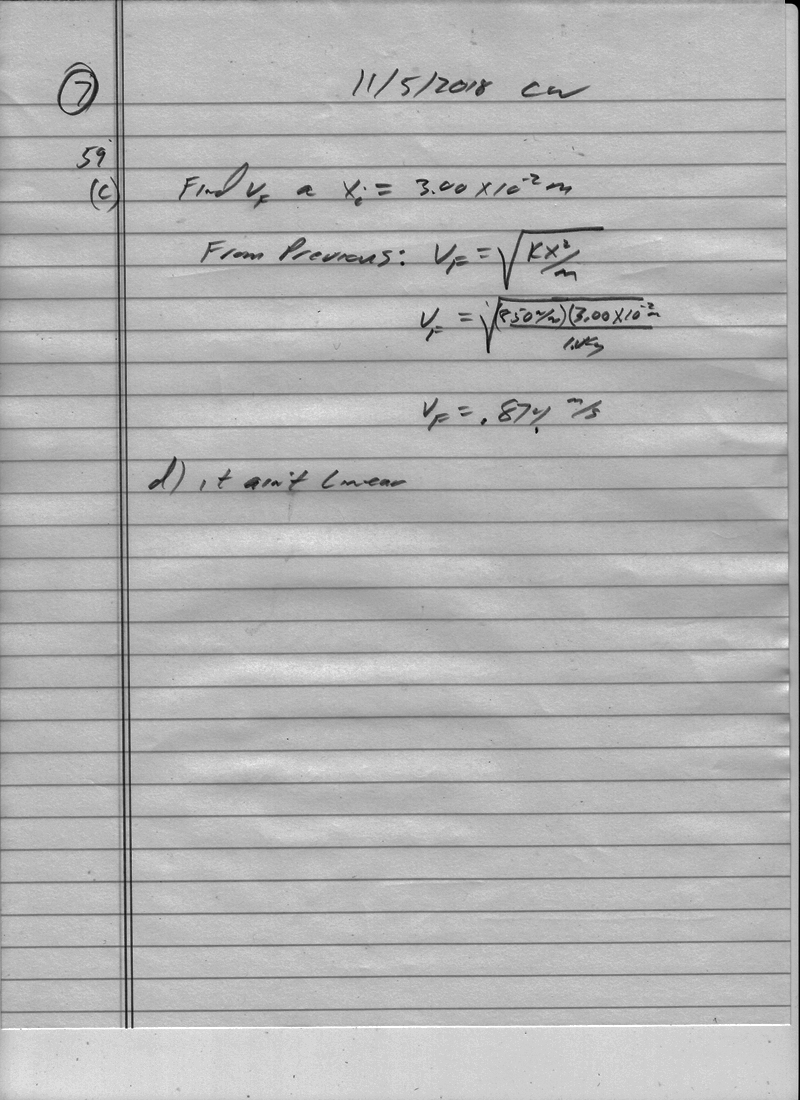
problems 26, 29, 30, 39, 46, 59, 64?
ANSWERS:
Hi everyone -- I'm up at the Kingston Ferry Doc heading over to Edmonds and just realized I don't have problem 26 answers loaded. I'll get that updated late this evening or tomorrow.... thanks!